Movement of Thanksgiving

Nicole Villeneuve - 11/15/2023

In 1939, FDR moved Thanksgiving up a week.

Famous Figures

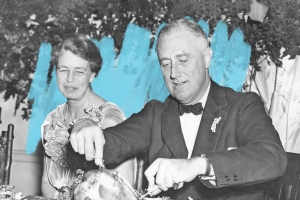
For a brief time in American history, part of the country celebrated "Franksgiving.” In 1939, President Franklin D. Roosevelt attempted to boost the economy by moving Thanksgiving up a week, making extra time for holiday shopping. FDR claimed the move was made at the request of big retailers, and many stores rejoiced at the change. But other institutions fought against it: Smaller retailers, colleges, football officials, the press, and even some turkey sellers protested the date change. Americans had celebrated Thanksgiving on the last Thursday in November since 1863, following the tradition started by Abraham Lincoln. Thanksgiving wasn’t a fixed date, however, and it was up to each president to choose when to observe the holiday. In 1939, the last Thursday of the month was November 30, and FDR chose to hold Thanksgiving on November 23 instead. 

The decision, announced in August 1939, was met with mixed reactions, primarily following party lines. Republican governors wanted to stick with tradition and dubbed the new date "Franksgiving,” while Democrats followed the president. The result was two Thanksgivings that year: Twenty-three states and the District of Columbia celebrated the new date, while 22 states stuck with November 30. Three states — Colorado, Mississippi, and Texas — celebrated both. The earlier date stuck for another two years, even as questions lingered about whether the extended shopping season actually helped retailers. In June 1941, Roosevelt announced without fanfare that Thanksgiving would be held on  the fourth (rather than last) Thursday of November, where it has remained ever since. 

FOLLOW US

JOIN THE VFW

Join us as brothers and sisters of America to preserve the rights of veterans and support each other as only those who share in the camaraderie forged by conflict can.